


The Cognitive Cost of Constant Overstimulation
Modern life has trained many people to function in a near-constant state of stimulation.
Notifications. Multitasking. Continuous task-switching. Back-to-back responsibilities. Constant urgency. Pressure to remain productive, responsive, available, and mentally “on” at all times.
Over time, many individuals adapt to this level of overload without fully recognizing what it may be doing to their thinking, emotional regulation, nervous system health, creativity, relationships, decision-making, and overall human capacity.
As conversations surrounding artificial intelligence, automation, productivity, and optimization continue accelerating, another important conversation is emerging alongside them:
What is constant overstimulation doing to the human mind and nervous system itself?
The Illusion of Multitasking

Modern neuroscience increasingly challenges the long-standing belief that humans are effective multitaskers.
Research suggests the brain is not truly performing multiple cognitively demanding tasks simultaneously, but rapidly switching attention back and forth between them instead — a process commonly referred to as task-switching.
Stanford University researcher Clifford Nass, known for his work on multitasking and media consumption, found that individuals exposed to high levels of constant information switching often performed worse on tasks involving attention, memory, filtering irrelevant information, and cognitive control (Ophir, Nass, & Wagner, 2009).
Additional research in neuroscience and organizational psychology continues exploring how chronic attention fragmentation, cognitive overload, and constant task-switching may contribute to mental fatigue, decreased focus, emotional exhaustion, reduced decision-making quality, and diminished cognitive performance over time (NeuroLeadership Institute, 2024).
While rapid task-switching may create the illusion of efficiency, the nervous system and brain still absorb the cumulative effects of prolonged stimulation, divided attention, urgency, and cognitive overload.
Exhausted minds rarely produce their clearest thinking long term.
Recovered attention matters.
Mental spaciousness matters.
Recovery matters.
The ability to pause, think strategically, regulate emotionally, remain present, connect meaningfully with others, and access creativity can gradually diminish under chronic overload and continuous stimulation.SS
When Overload Becomes Normal
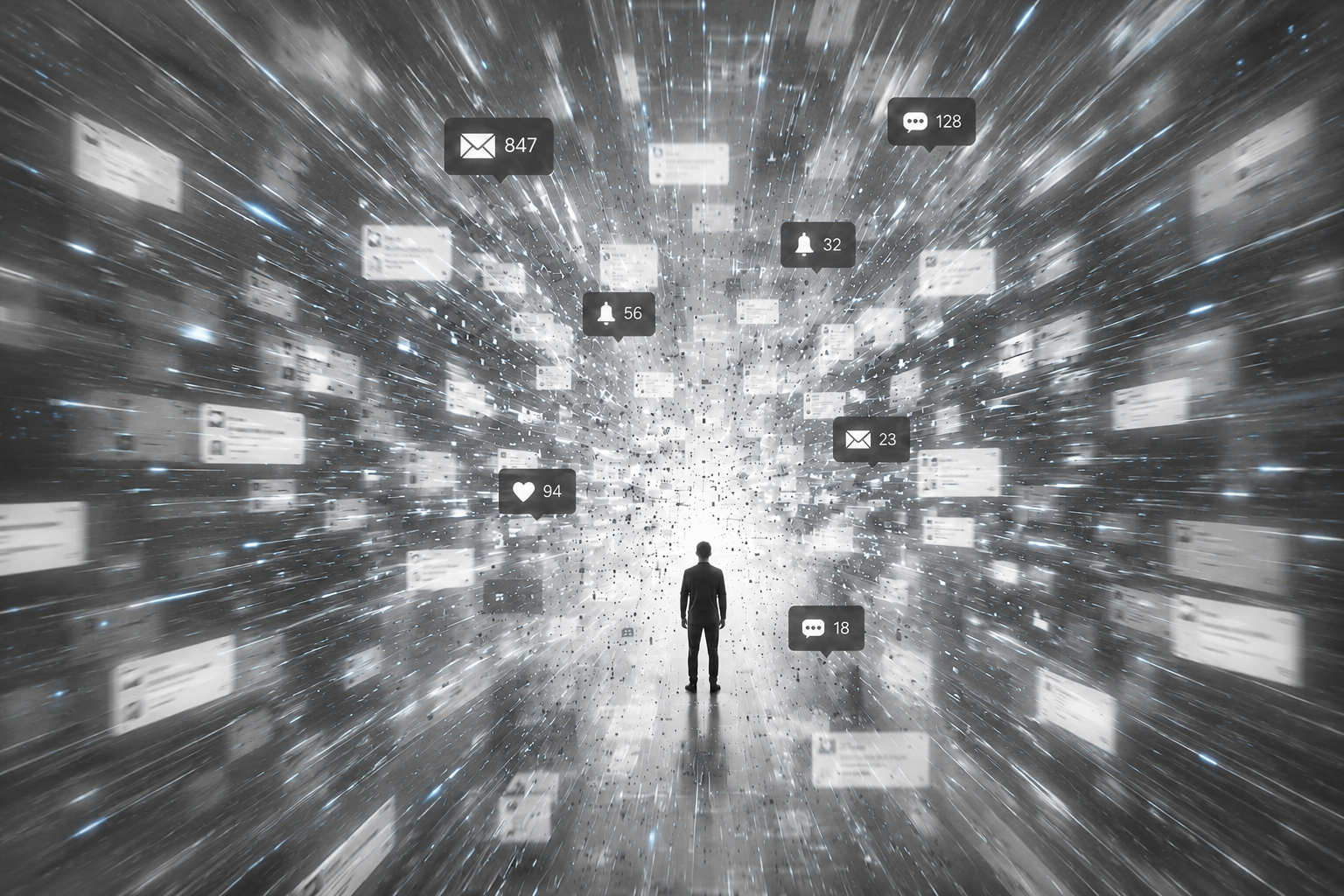
Many people today continue functioning at high levels externally while internally feeling mentally depleted, emotionally disconnected, physically exhausted, or unable to fully slow down.
Over time, functioning while overwhelmed can start feeling familiar. Ignoring internal signals becomes automatic. Rest may even begin triggering guilt instead of recovery.
The World Health Organization (2019) recognizes burnout as an occupational phenomenon resulting from chronic workplace stress that has not been successfully managed. Symptoms may include exhaustion, emotional depletion, irritability, sleep disruption, reduced professional effectiveness, cynicism, difficulty concentrating, and increased mental distance from work.
Part of what makes chronic overload difficult to recognize is that many individuals remain highly functional while experiencing it.
Different role. Different schedule. Different environment.
Yet somehow, the same exhaustion slowly returns.
In many cases, people unknowingly recreate similar stress patterns because the nervous system has adapted to operating in prolonged states of urgency, hyper-responsibility, overstimulation, and constant output.
Human Intelligence Extends Beyond Productivity

Human intelligence is far more complex than productivity alone.
Focused attention.
Cognitive flexibility.
Emotional regulation.
Mental clarity.
Strategic thinking.
Meaningful connection.
Discernment.
Creativity.
Intuitive intelligence.
These are deeply human capacities that often require recovery, internal awareness, nervous system regulation, and mental space to function well long term.
Intuitive intelligence is often misunderstood. It is not simply impulsive reaction or vague instinct. In many cases, it reflects subtle pattern recognition, internal awareness, accumulated experience, emotional discernment, and the ability to sense misalignment before it fully manifests externally.
Yet modern environments filled with constant noise, urgency, distraction, and overstimulation can gradually disconnect people from those quieter internal signals.
Sometimes the body recognizes imbalance long before the conscious mind fully does.
Fatigue.
Brain fog.
Anxiety.
Irritability.
Sleep disruption.
Emotional numbness.
Difficulty concentrating.
Feeling disconnected from joy, meaning, or presence.
These are not always signs of weakness. In many cases, they are signals that the mind, body, and nervous system have been carrying more than they were designed to sustain continuously.
The Importance of Pause and Recovery

This conversation is deeply personal for me as well as professional.
Experiencing chronic overload firsthand taught me that recovery often requires more than mental reframing alone. Over time, prolonged stress can affect individuals mentally, emotionally, physically, and internally in ways many people underestimate.
As Dr. Bessel van der Kolk explained in The Body Keeps the Score, emotional experiences and prolonged stress can become deeply embedded within the nervous system and body itself (van der Kolk, 2014).
Healing often involves rebuilding a healthier relationship with the body, emotional regulation, recovery, support systems, internal awareness, and the unconscious beliefs that quietly shape behavior over time.
Even small moments of pause can significantly impact cognitive and emotional well-being.
In environments filled with constant stimulation, many people rarely allow the mind or nervous system enough space to fully process thoughts, emotions, experiences, or internal signals.
This is one reason practices such as meditation, mindfulness, breathwork, reflection, and intentional quiet have become increasingly popular in recent years. Beyond stress reduction alone, these practices can create the mental spaciousness necessary for deeper emotional processing, creativity, internal awareness, and cognitive recovery.
Research in neuroscience and psychology continues exploring how mindfulness and focused attention practices may positively influence emotional regulation, stress response, cognitive flexibility, and overall mental well-being (Goleman & Davidson, 2017).
When people slow down enough to pause intentionally, they often begin noticing thoughts, emotions, patterns, and internal signals that constant overstimulation can easily drown out.
Some of the most important insights do not emerge during periods of maximum stimulation, but during moments when the nervous system finally feels safe enough to slow down and process more deeply.
Sustainable Human Performance
As conversations around artificial intelligence, optimization, and productivity continue accelerating, the discussion cannot revolve around efficiency alone.
Human intelligence has limits. Human attention has limits. Human nervous systems have limits. AI has limits too.
The future is not built through efficiency alone.
It is shaped by awareness, discernment, ethics, emotional intelligence, intuitive intelligence, recovery, meaningful connection, and the ability to remain connected to ourselves in increasingly overstimulated environments.
#HumanIntelligence #Leadership #Cognitive Performance #EmotionalIntelligence #Neuroscience #BurnoutPrevention #FutureOfWork #AttentionEconomy #MentalHealth #HumanBehavior #IntuitiveIntelligence #SustainablePerformance #AI #TheAlignedReset #LeadershipDevelopment
If this resonates, you can learn more about our framework, THE ALIGNED RESET™ at TheAlignedReset.com.
References
American Psychological Association. (2023). Stress effects on the body. https://www.apa.org/topics/stress/body
Goleman, D., & Davidson, R. J. (2017). Altered traits: Science reveals how meditation changes your mind, brain, and body. Avery.
Mayo Clinic Staff. (2024). Job burnout: How to spot it and take action. Mayo Clinic. https://www.mayoclinic.org/healthy-lifestyle/adult-health/in-depth/burnout/art-20046642
NeuroLeadership Institute. (2024). Attention fragmentation and cognitive overload in modern work environments. https://neuroleadership.com
Ophir, E., Nass, C., & Wagner, A. D. (2009). Cognitive control in media multitaskers. Proceedings of the National Academy of Sciences, 106(37), 15583–15587. https://doi.org/10.1073/pnas.0903620106
van der Kolk, B. A. (2014). The body keeps the score: Brain, mind, and body in the healing of trauma. Viking.
World Health Organization. (2019). Burn-out an “occupational phenomenon”: International Classification of Diseases. https://www.who.int/news-room/questions-and-answers/item/burn-out-an-occupational-phenomenon